If your high-volume, heavy-gauge components are still competing for time on a laser, the issue is no longer flexibility—it’s economics. Laser cutting remains one of the most valuable tools in modern fabrication. It allows engineers to iterate quickly, adjust geometry without tooling changes, and move from concept to prototype with minimal friction. For early-stage programs and short runs, it is often the right answer.
The challenge begins when a design stabilizes and annual usage climbs. At that point, what once felt lean can quietly become inefficient. Running thick structural components on a laser long after the geometry is locked may protect you from an upfront tooling investment, but it can also lock you into a cost structure that will not scale.
Moving to heavy-gauge stamping represents a structural shift in how a part is produced. Instead of measuring machine time in minutes per part, you move to a production model measured in parts per minute. For OEMs building in volume, that difference compounds quickly, transforming a slow, sequential process into a high-velocity supply chain advantage.
Laser Cutting vs Heavy Gauge Metal Stamping for High Volume Production
The most common reason manufacturers stay with laser cutting is simple: Tooling requires capital, laser cutting does not. On paper, that feels conservative and low risk.
However, laser cutting is inherently sequential and—crucially—limited to a single plane. If your part requires bending, coining, or forming, the laser is only the first stop in a multi-station journey. That laser-cut blank must be stacked, moved, and set up on a press brake or robotic bending cell. This creates a “logistical tail” of additional machines, multiple setups, and increased labor costs. Even with automation, your throughput is governed by the slowest secondary operation.
Heavy stamping operates differently. On an 800-ton press, blanking, coining, piercing, and forming can occur in a single stroke or through progressive stages within a single engineered die. Once the tool is validated, production becomes a repeatable mechanical event. Setup is amortized over tens of thousands of cycles. By consolidating multiple steps into one continuous motion, the part emerges from the press complete—eliminating the lag and labor inherent in moving through separate, sequential operations.
Why Laser Cutting Costs Plateau as Volume Increases
Procurement teams often experience the same progression. As annual quantities rise, they push for incremental price reductions from their laser supplier. At first, discounts appear. Eventually, they stop. This is not a negotiation problem—it is a process limitation.
Laser cost is dominated by time and consumables. No matter how strong the relationship, there is only so much efficiency to extract from a sequential cutting process. Stamping, by contrast, front-loads cost into tooling to lower marginal production cost dramatically. By moving from flat blanks to a coil-to-complete production model, you stop paying for flexibility you no longer need and start capturing the compounding returns of an optimized manufacturing process.
There is also opportunity cost. When lasers are tied up producing stable, high-volume components, they are unavailable for the prototyping and R&D work they were designed to support. Moving established parts to a high-tonnage stamping line frees those assets to do what they do best: iterate.
800 Ton Press Capacity for Thick Steel Stamping up to 1/2 Inch

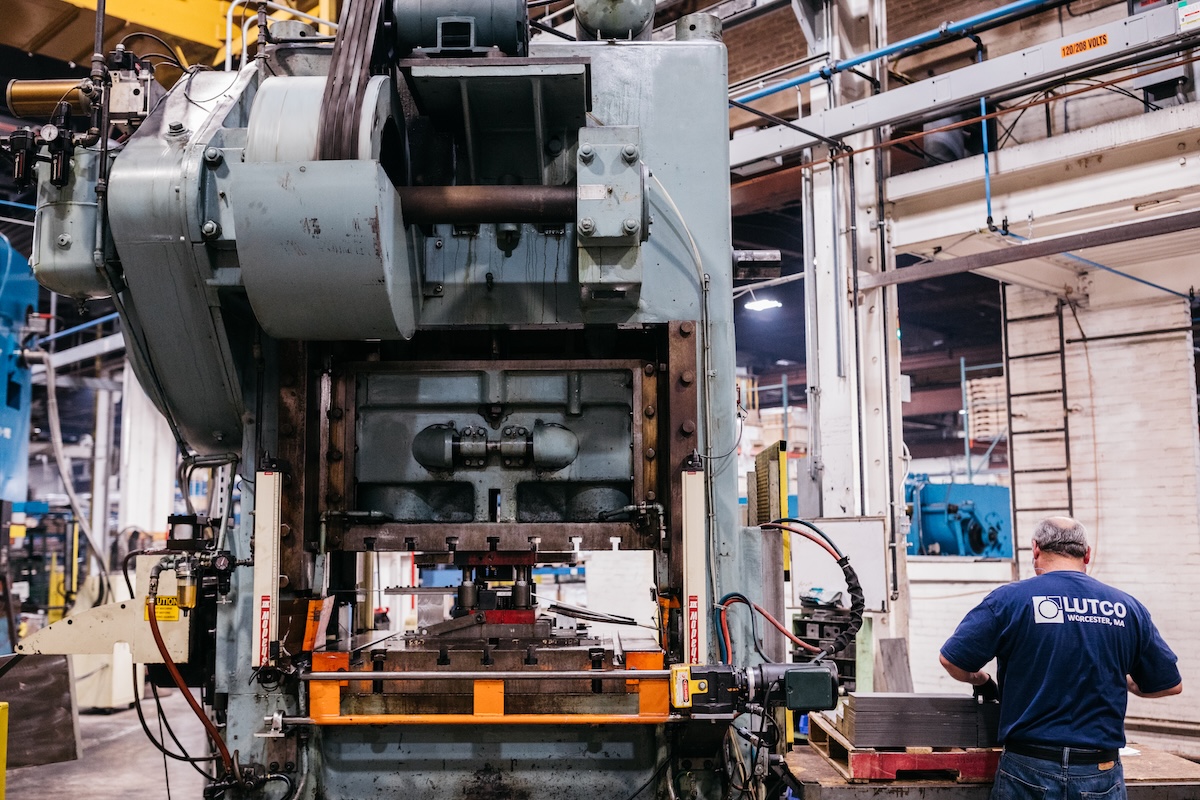
A thick steel component stamped on Lutco’s 800-ton heavy stamping press.
Heavy gauge stamping is not simply “bigger stamping,” it is a different capability tier. Structural components in trucking, agricultural equipment, snow and ice control systems, and industrial machinery frequently require thick carbon steel, stainless, or HSLA. Thicknesses approaching half an inch are common, and many presses are not built to handle this consistently.
Utilizing Lutco’s 800-ton press capability bridges the gap between light fabrication and heavy structural manufacturing. Our high-tonnage equipment features a 109” by 54” bed size and accommodates massive die sets up to 50” x 104”. This scale allows a single custom-engineered tool to perform blanking, piercing, and forming operations simultaneously, maintaining tight tolerances even on the largest components.
- Progressive and Compound Dies: Lutco uses progressive dies to move heavy steel strips through multiple stations, performing complex forming operations in a single pass. This shifts production to a high-velocity output where finished parts emerge from the machine ready for assembly.
- Verified Capacity: While many shops cap out at 1/4″ thickness, Lutco’s high-tonnage press handles blanking and piercing for materials up to 0.500” (1/2 inch) and forming up to 0.375” (3/8 inch). This allows for the production of massive, structural components that remain consistent across tens of thousands of cycles.
- The Cold-Working Advantage: Laser cutting is a thermal process that introduces intense heat to the edge of the part. This creates a Heat-Affected Zone (HAZ) that can harden the material’s edge, making it difficult to drill or tap and requiring extra grinding before welding. Stamping is a cold-working process that preserves the metal’s original temper and structural integrity. This provides a clean, consistent edge that is ready for immediate secondary assembly, resulting in better weld penetration and reduced tool wear on your own production line.
An 800-ton press with a large bed size provides the force and stability required to blank and form heavy sections without excessive deflection or tool stress. High tonnage ensures clean sheared edges, controlled forming, and dimensional repeatability across long production runs.
Progressive and Compound Die Stamping for Structural Steel Components
 Tooling strategy determines whether stamping delivers its full economic value. In a progressive die, heavy strip steel advances through multiple stations. Each stroke performs a defined operation. Piercing, shaping, and forming occur in sequence within a single tool set. Compound dies can perform multiple cutting operations simultaneously.
The benefit is not just speed; it is also consistency of output and the elimination of secondary handling. Structural brackets, mounting plates, and reinforcement components are produced with repeatable geometry that simplifies downstream welding and assembly. When tolerances remain stable from part to part, and the forming is integrated into the primary stroke, your total manufacturing cycle shrinks.
Vendor Managed Inventory Programs for High Volume Metal Stamping
One persistent concern about stamping is minimum order quantity (MOQ). High-speed production often implies large batch runs and significant inventory exposure. In practice, that risk can be managed.
Lutco bridges this gap through tailored inventory management programs that align our high-velocity output with your actual consumption. By using blanket orders and Just-In-Time (JIT) release schedules, we enable you to capture the economies of scale inherent in an 800-ton press while maintaining a lean footprint on your factory floor.
This approach stabilizes pricing, reduces material volatility exposure, and preserves working capital flexibility. Stamping becomes a supply chain strategy rather than a storage problem.
Signs It Is Time to Move from Laser Cutting to High Tonnage Stamping
There is no universal volume threshold that dictates when to switch processes. Instead, the decision to pivot from laser cutting to high-tonnage stamping is revealed through specific operational triggers:
The Design Lock
Laser cutting is built for iteration. If your component geometry hasn’t changed in over a year, you are paying a premium for flexibility you no longer utilize. Once a design is “locked,” the financial priority must shift from adaptability to unit-cost optimization.
The Efficiency Ceiling
Procurement teams often hit a wall where, despite rising annual demand, their laser supplier can no longer offer incremental price reductions. This isn’t a lack of goodwill; it is a process limitation. Laser costs are dominated by fixed machine-time and gas consumption. Stamping breaks through this ceiling by front-loading cost into tooling to achieve a drastically lower marginal production cost.
Throughput Elasticity
If peak seasonal demand creates a bottleneck because your sequential cutting process cannot “flex” fast enough to meet the surge, the process is constraining your growth. An 800-ton press provides the elasticity to build a strategic buffer of parts in days rather than weeks, ensuring that your assembly line is never waiting on a laser head to finish a perimeter.
Sequential Drag
Laser cutting only solves for the flat blank. If those blanks are spending days waiting for a press brake or a robotic bending cell, your process is creating unnecessary work-in-progress (WIP) and excess labor costs. The move to a progressive die eliminates operational bottlenecks by delivering a finished, formed component in a single operation, removing the need for secondary handling entirely.
Supply Chain Fragmentation
If your current process involves one vendor for cutting, another for heat treating, and a third for secondary welding or assembly, you are paying a “hidden tax” in the form of logistical drag and lead-time variability. Managing multiple hand-offs for a single component increases the risk of quality disputes and transit damage. The most effective time to pivot is when the administrative cost of coordinating these fragments outweighs the cost of the tooling required to bring the part under a single, vertically integrated roof.
Integrated Blanking, Forming, Heat Treating, and Assembly Under One Roof
As a comprehensive contract manufacturing partner, Lutco provides the infrastructure to move a part from coil to complete. Instead of coordinating multiple vendors, procurement teams can issue a single purchase order for a finished structural component. For critical assemblies such as snow plow A-frames and heavy mounting brackets, this integration removes logistical drag and eliminates the variability that arises across vendors.
The decision to move to heavy-gauge metal stamping should be grounded in data. If your volumes are increasing, your designs are stable, and sequential processing—and the secondary bending it requires—is beginning to compress your margins, it is time to evaluate the high-tonnage path.
Accelerate production from minutes-per-part to parts-per-minute.
Don’t let sequential fabrication limit your growth. If your designs are stable, volumes are rising, and your supply chain is becoming too complex, it’s time to run the numbers on high-tonnage stamping.