
Industry: Infrastructure & Fastening | Part: Direct Tension Indicator (DTI) Washers | Result: 300k+ annual units with 100% lot traceability and zero geometric failures.
A leading provider of structural fastening solutions required a manufacturing partner to scale production for a Direct Tension Indicator (DTI). While visually similar to a simple flat washer, a DTI is a functional mechanical sensor used to provide visual verification of bolt tension.
The project presented three primary challenges:
- Critical Functional Geometry: The part features embossed cavities that must be formed to exact heights. These cavities hold the silicone that is pushed out to signal when proper torque is achieved.
- High-Volume Production: With projected annual volumes to exceed 900,000 pieces, the process required extreme efficiency to remain viable without sacrificing quality.
- Strict Logistical Requirements: Due to the safety-critical nature of structural bolting, the customer mandated absolute lot traceability, prohibiting mixing of material batches across lot numbers.
Engineering Analysis: Precision Forming at Scale
The engineering team at Lutco identified that the success of the DTI depends entirely on the repeatability of the alloy steel displacement during the stamping process.
The progressive tooling must account for the material’s specific flow characteristics to ensure consistent cavity geometry. The progressive tooling must meet tight product tolerances to ensure the tension-indicating silicone propagates correctly and provides a visual indication of the proper torque range.
Furthermore, high-volume production at 50 parts per minute (PPM) introduces the risk of “tooling drift,” where heat and wear subtly alter the part’s geometry over a long production run.
Integrated Progressive Stamping and Rigorous Quality Controls
Lutco developed a comprehensive production strategy that integrated precision metal forming with a disciplined logistical framework.
- Optimized Progressive Tooling
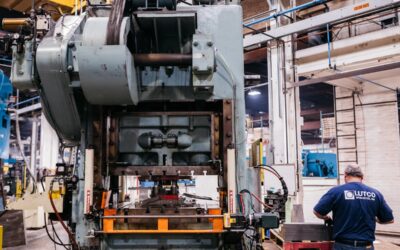
Lutco engineered a progressive die capable of performing both the blanking and the complex forming of the indicator cavities in a single continuous operation. This ensures concentricity and reduces the tolerance stack-up inherent in secondary operations.
- High-Frequency Inspection Protocol
To mitigate the risks of high-speed production, a 30-minute inspection interval was implemented. This allows the production team to monitor geometric consistency in near real-time, ensuring that every part meets the critical height specifications for the tension cavities.
- Advanced Lot Management
To meet the “zero-mix” traceability requirement, Lutco overhauled the floor logistics for this project, developing a dedicated cell that would ensure strict lot segregation and end-to-end traceability throughout the manufacturing process. Raw material batches are isolated from the moment of receipt through the stamping, tumbling (deburring), and final packaging stages.
In the first round of production, Lutco successfully delivered over 300,000 units, with annual planned volumes to approach 1 million parts.
- Consistency: High-frequency audits confirmed that cavity geometry remained within spec across the entire volume.
- Logistical Reliability: Documentation and lot segregation met all structural safety standards.
- Growth: Based on the success of this initial part, Lutco is currently expanding the program to include additional sizes in English and Metric (USC and SI variations) of the same basic DTI design.
Solve Your High-Volume Stamping Challenges At Lutco
Do you need complex functional geometry or rigorous lot control? Lutco’s engineering team can develop a solution tailored to your application.